
Artificial intelligence is increasingly recognized as a tool in the office for public relations. As AI continues to evolve, its potential applications are moving into the physical world, including agriculture.
For farmers, that could mean using AI to reduce administrative work, make better use of data and, eventually, help with some of the most physically demanding aspects of farming.
Henry Kim, a professor at York University who researches emerging technologies and their applications, sees particular promise in what is known as physical AI, as it can interact with the physical world through technologies such as robotics, cameras and sensors.
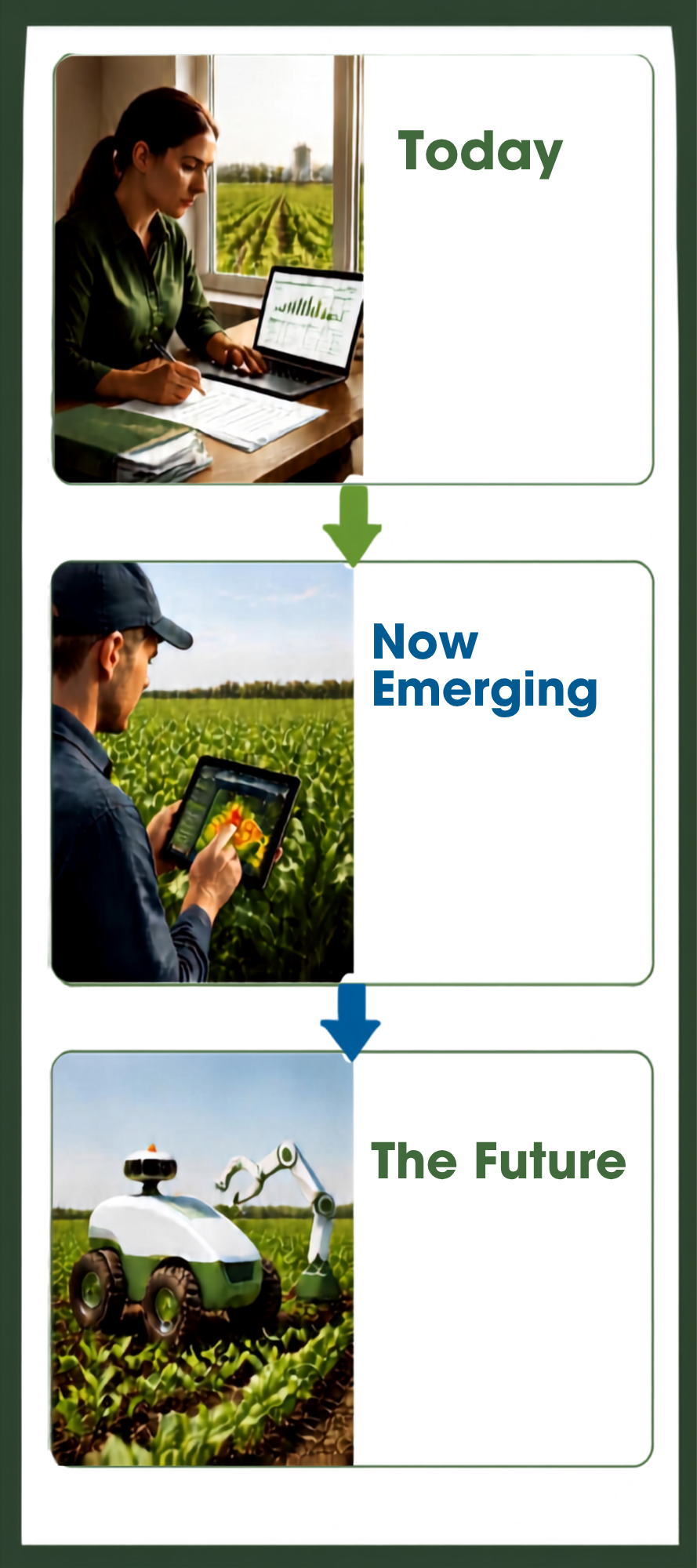
 Rather than being a tool on a computer screen, physical AI allows machines to use information about their surroundings to make decisions and carry out physical tasks. In agriculture, that could eventually mean robots identifying ripe crops and harvesting them, machines detecting weeds or crop stress, or autonomous equipment navigating fields and completing repetitive work. In fact, some of these applications are already well underway.
For an industry where many tasks remain physically demanding and labour-intensive, the potential is significant.
Can Robots Help Fill the Labour Gap?
“I think what I find really interesting and exciting is what is called physical AI, which is like the next generation of robotics,” Kim said.
Labour availability is one area where physical AI could have a practical role. During busy periods such as harvest, farms can face shortages of workers for tasks that need to be completed quickly.
Kim believes robotics could eventually help address some of those challenges by taking on repetitive or physically demanding work.
The technology is still developing, and Kim cautions against predicting exactly what agriculture will look like five or ten years from now. He sees agriculture as an industry where physical AI has an opportunity for contribution.
“You can see the implications in agriculture, which is so manually intensive,” Kim said.
He sees physical AI as a potential way to extend some of the productivity gains already being seen with digital AI into more hands-on work.
“Farming is very manual,” he said. “In that sense, I think farming is right for that.”
The Bottom Line: Does AI Pay?
 The potential benefits may be easier to realize on larger farms, where the cost of investing in automation can be spread across more acres and operations.
For smaller farms, the economics can be more challenging. Purchasing and implementing new technology requires an investment, and the benefits need to justify that cost.
“That’s the issue with AI and smaller farms,” Kim said. “It just doesn’t make sense economically” in some cases.
That makes return on investment an important consideration when farmers are deciding whether a new technology belongs on their operation.
What Farmers Can Do with AI Today?
While robotics may represent the future of physical AI in agriculture, farmers do not necessarily have to wait for the next generation of technology to benefit from AI. Kim sees immediate opportunities in some of the everyday administrative tasks that come with running a farm.
Large language models, such as ChatGPT and Claude, can help users quickly work through large amounts of information. For farmers, that could include navigating regulations, summarizing lengthy documents or assisting with other administrative tasks.
“I think the immediate win for any farmer is productive use of data,” Kim said.
For farmers, who are producers, business owners and entrepreneurs, saving time can have real value. An AI tool that can help reduce time spent on paperwork or information gathering may allow farmers to spend more time focused on the operation itself.
AI tools are also being developed for more agriculture-specific applications. Kim pointed to technologies that allow users to take photographs of plants or other farm-related problems and receive information that could help with diagnosis.
The key, however, is not simply adopting technology because it is new.
Return On Investment
 Kim repeatedly returned to one principle when discussing technology in agriculture: return on investment matters.
“If you can’t show return on investment, then it wasn’t worth investing,” he said.
That is particularly important in agriculture, where margins can be tight and technology investments can be significant.
The same principle applies when considering another emerging technology, blockchain.
Kim has worked with blockchain applications involving traceability, including efforts to establish the origins of Canadian agricultural products. Blockchain has been discussed as a way to provide greater transparency in food supply chains, but Kim said some applications have struggled to reach a larger scale because they require participation from many different producers, suppliers and other stakeholders.
AI, in contrast, already has applications where the productivity gains are easier to demonstrate.
That does not mean every AI application will succeed. Rather, it suggests that farmers should look at emerging technologies through a practical lens and ask themselves: What problem does this solve, and is the benefit worth the investment?
AI may also have a role beyond individual farms.
Making ConnectON Smarter
Kim discussed work involving ConnectON, a province-wide economic development and asset-mapping platform that brings together geo-mapped business, agricultural and agri-food data. It is a tool that helps municipalities understand their local and regional economies. It also supports municipal planning, investment attraction, business retention and expansion by helping users identify businesses, supply chains, trends and opportunities across Ontario.
For example, someone planning a new food processing facility could use the database to identify nearby farms that produce a particular crop.
The research team has explored whether an AI-powered chatbot could make the information easier to access. Instead of navigating a database manually, a user could potentially ask a question in natural language, such as finding strawberry farms within a certain distance of a community. It is an example of how AI does not necessarily have to replace existing agricultural systems. Its role is simply to make information that already exists easier for people to access and use.
Learn Now. Benefit Later.
For farmers considering where AI fits into their businesses,  Kim’s advice is straightforward: start learning.
To explain why, he drew a comparison to Canadian hockey.
Kim pointed to the well-known observation that elite Canadian hockey players are disproportionately born earlier in the selection year. When children are very young, even a few months of age can create a physical advantage. Those children may be more likely to make higher-level teams, where they receive better coaching and competition. That initial advantage can then compound over time.
Kim sees a similar opportunity with AI.
“If you can just learn how to use that better than other people now,” he said, “this just means that you will actually raise that gulf between you and other people.”
The comparison is not about becoming an AI expert overnight. Instead, it is about recognizing that small differences in knowledge can become increasingly valuable as a technology becomes more widely used.
“At this stage, it’s worthwhile learning about this technology because a little difference now will grow to a big difference in the future,” Kim said.
For agriculture, that learning curve could extend to using AI to sort through regulations and data or potentially working alongside intelligent machines in the future.
The technology may not have all the answers yet. But for farmers, understanding what AI can do, where it makes economic sense and how it can solve real problems may be just as important as the technology itself.